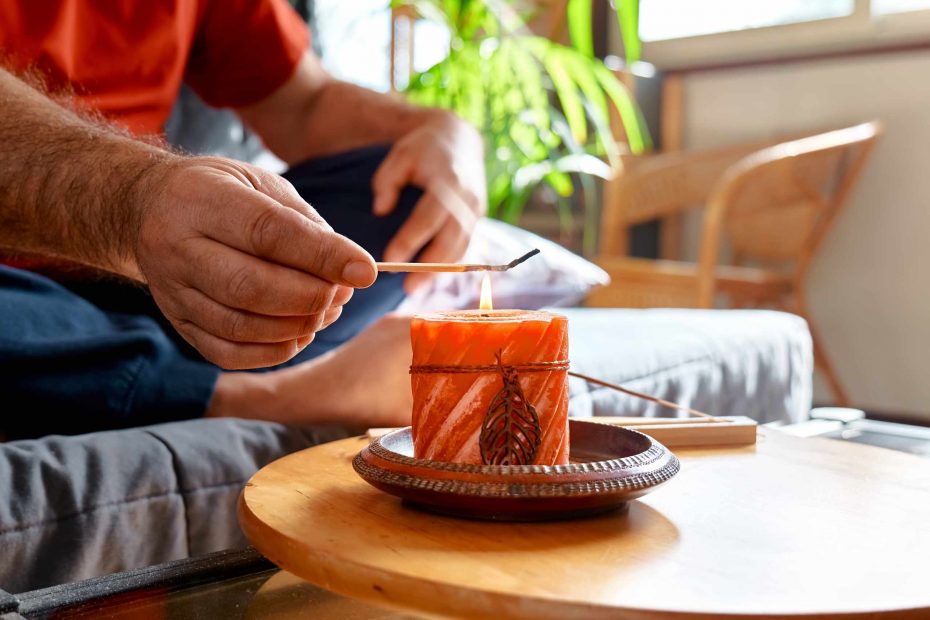
On the candle-making table, the fragrance bottle is usually the most fun piece of equipment. You could melt flakes of wax, drop in a wick, fill a heat-safe jar (not even that creative, you’d think), and it all looks kind of simple. But the fragrance oil is when the candles get personal, and you can see your vision in the bottle. The problem is the temptation to just dump in the fragrance oil, especially when your melted wax in the pitcher doesn’t smell strong enough. A good starter candle has an accurate and measured fragrance load and not a little bit of added fragrance with the hope it will work.
You need the exact amount of fragrance that fits in the exact amount of wax you’re using. Each and every candle wax will only hold up to a specific maximum fragrance before you lose your ability to make an accurate candle. An overload of fragrance can negatively affect the candle’s set, cause the surface to appear oily, and reduce your ability to make an accurate burn check down the road. On the other hand, too little can lead to a candle that barely smells at all. But at a beginner level, a lightly scented candle is much easier to learn from than a candle with several issues, including the fact that you put in a fragrance overload.
Don’t eyeball the fragrance load on the bottle. Use a scale. You should use the candle-making ingredients the way you’d use ingredients in a small batch recipe. The weight of the fragrance oil comes from the weight of the wax. Check the instructions for whatever wax you’re using for guidance on the best fragrance load for that wax. As a beginner candle maker, use whatever fragrance percentage you see suggested in the instructions. This isn’t to make a scent so weak that no one wants to light the candle. It’s to give the wax a reasonable chance to combine with the fragrance oil and set with a less oily surface.
Pay attention to the temperature at which you’re adding the fragrance oil, too. The wax can be too hot when the oil gets added and lose too much scent before it cools and sets. The wax could also be getting ready to set, in which case the oil and wax don’t have the chance to blend fully before it cools. Keep a thermometer on the melting pitcher to get the temperature of the wax before adding the fragrance oil. Stir it slowly but thoroughly using a clean stirrer once added. Overly rapid stirring mixes in air but gentle stirring doesn’t fully mix in all the fragrance. Slow and steady, with enough agitation to mix the whole batch, is the right balance.
Make a trial candle that only uses one fragrance and no dye. Record the measurements you used: how much your wax and fragrance weigh, the temperature at which you added the oil, how much you stirred it for, what temperature you poured it at, and what the surface looked like as it set. This may sound like over-annotation for making a single candle. It is also the difference between you guessing which problem may have occurred and you having clear direction when looking at your result. Is the top oily? You can look at your measurements to see if you put in too much fragrance. If the candle smells light, you know to check your measurements of temperature and stirring.
A beginner-level difficulty in fragrance measurement is having a warm, melted pitcher of wax that just doesn’t smell as strongly as you would like and having a finished candle that does. The candle you melt in your pitcher is not as aromatic as the candle you are cooling. The candle you are cooling does not smell as strongly as the candle you have finished, trimmed, and lit. If your wax seems weak and you add in extra fragrance, you’re likely to run into more issues, and you’re also going to miss when you can’t smell the candle’s strength and you’ve made a problem you won’t see until much later. Let the candle cool properly, check if there’s an oil spot on the surface, trim the wick, and then look at the candle. Your candle journal will help you see the pattern, or simply make that observation and move on.
Fragrance measuring is easier when you treat it as part of your candle setup and not as an add-on step you perform after your wax is ready. Take out a scale, the fragrance bottle, a few paper towels, and whatever notes you’ll be referring to, and put them on your candle-making surface. As you pour, if you have to wipe up any fragrance on the outside of the bottle, do it then. If you want a second fragrance, put it on the scale and pour it after you clean your work surface. Once you start doing this, you can get a clearer picture of your candle: how well it’s cooled and what the surface looks like. From there, you can make a decision on whether you need to adjust the next pour.